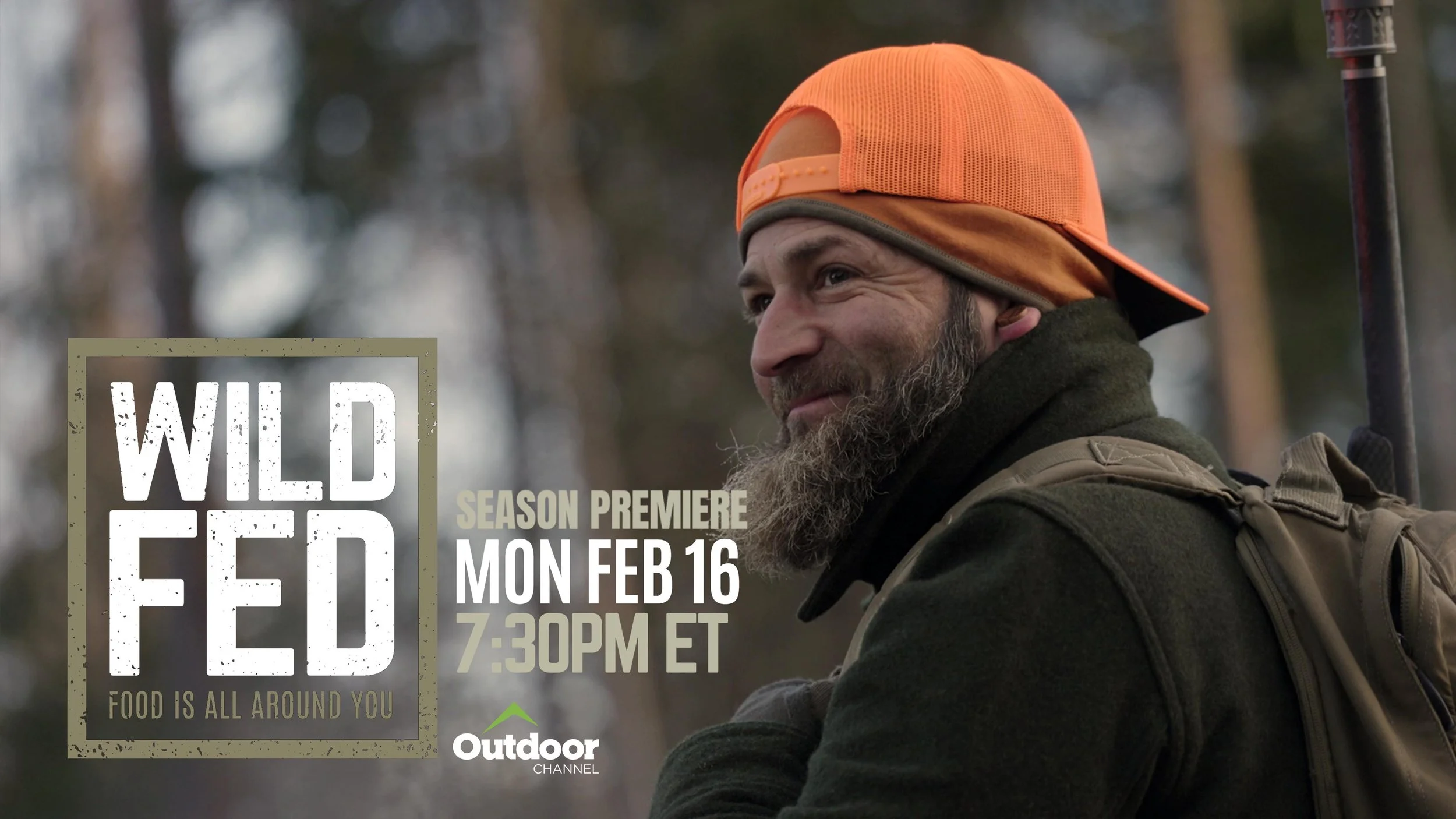
WildFed is a culinary adventure tv series and podcast about hunting, fishing, foraging, and turning wild ingredients into delicious meals.
The Latest from The WildFed Podcast
Well, it’s finally here. The last interview of the WildFed Podcast. We'll be back next week with our producer Grant to do a final wrap-up, but as far as guest appearances go, who better to take us out than Dan Flores, and on what better topic than his new book, Wild New World. The book is incredible, even, dare we say, required reading for anyone who’s been following the journey of this podcast. It’s not just a history of North America and the animals that live here now — the extant animals — and the ones that were here before — the extinct ones. It’s also the story of the human predator crossing through Beringia and being unleashed on a homonin-naive megafauna assemblage and the impacts that would have here over the proceeding 20,000 years or so.
It traces its way through the Clovis and Folsom cultures, to the post-ice-age extinction events that led to the great mass of cultures we refer to as Native American, up to the point of contact with European explorers. Then, what follows, as we are all painfully aware, is the Great Dying, which led to the loss of some 80-90% of the indigenous peoples of the continent due to diseases that Europeans had developed significant immunity to but were novel to Native America. And of course, colonization and westward expansion. This then gives way to the most substantial human-induced biomass reduction in known history, the denuding of the land and the commodification of its wildlife — which comes with it several tragic, high-profile extinctions. This part of the book is both compelling and at the same time gruesome and loathsome to read about. It’s truly a blemish on the history of this country and something we are a long way from reconciling still.
Eventually, this leads to the beginnings of the modern conservation movement, which carries us through to the present day, exploring both its sometimes less-than-savory origins, but also its tremendous wins, like the Endangered Species Act.
The book walks us through to the very present with some speculation about the future.
When Daniel last spoke to Dan, he'd only read a few chapters, and those were some feel-good pages. He didn’t really understand what was to come or how it would shake him to the core. He didn’t expect it would cause him to reevaluate many of his assumptions or make him audit his own practices and how they relate to this bigger-picture history.
It’s so easy to forget that we live, not as isolated points in space and time, but rather in a continuum. Embedded in a fabric of living history. Without context for what has come before, we can inadvertently focus myopically on where we are now. Conservation is no different. While our methods for wildlife management are light-years ahead of where they were just a century ago, one thing we've learned making this show is there’s still a LONG way to go. It’s far from perfect.
All that said, humans are and always have been — as long as our genus has existed — predators. Not just dietarily, but behaviorally. Those of us that hunt and fish know this in a very intimate way. The idea of giving that up is not really an option for most of us — despite the hopes of the planet’s vegan contingent who believes we can just implement a species-wide dietary experiment on the human population without any malnourishment consequences to ourselves or children. Daniel has been down that road and it leads, in his opinion, off the rails and into nutritional bankruptcy.
So, it seems to us that we need to learn to balance our needs, wants, and desires as a predatory animal with our needs, wants and desires for intact fauna and healthy ecosystems. No easy task. One that’s not just centuries, but millennia, in the making.
It seems to us that this decade could be characterized by a now hyper-connected and networked human race coming to terms with itself, its past, and its future. Those of us who champion a meaningful ecological trophic connection to wildlife are going to have to do the same. We hope, when the dust settles, we can still hunt, fish, and forage, since as Daniel has stated on this show dozens if not a hundred times — we think this is essentially human.
Who knows where this all leads, but we're grateful to Dan for this book and the incredible work that must have gone into writing such a sweeping ecological and environmental history. We suspect this one is destined to be a classic. Dan is, no doubt, one of the most important environmental writers of our day, and it’s an honor to have him back on the show — and especially as our final interview.
As we mentioned earlier, we'll be back next week for one final, more intimate episode of the show. Thank you so much for following along on this journey, for your support, and for your listenership. It has meant the world to us!
Now, here’s our second interview with Dan Flores on his newest book, Wild New World!
A.J. DeRosa is the founder of Project Upland — a multi-media operation that produces, in addition to video and web-based content, a quarterly, subscription-based premium print magazine. He’s also the author of the deer hunting cult-classic, The Urban Deer Complex. An accomplished hunter, rabid conservationist, and success in the hunting industry, he is not your typical hunter.
Whether it's his politics, which are woven as a through-line throughout his unique positions, or his insistence on activism as a key component of conservation, he occupies a space adjacent — and sometimes quite antithetical — to those typified by what could be seen as an often monolithic mindset amongst those that hunt or fish.
Daniel is someone who’s often felt like an outsider in the world of hunting, frequently expressing views that run counter to those of his fellow outdoorsman, and A.J. is altogether more revolutionary in his approach.
When we first met and heard him speak, it was a surprisingly refreshing, if not sometimes challenging, stream of consciousness we hadn’t heard expressed in hunting circles before.
Being some 6% or less of the American public, those of us that hunt, understandably, have more often than not, chosen to silo ourselves and as a result, have suffered from a kind of slow progress with respect to the rest of the public at large.
But A.J. is different. Different than any hunter or conservationist Daniel has sat down with yet. Don’t expect a rehashing of the same old talking points here. He’s not that guy. But, he might just be the foreshadowing of the voice of the future hunter. As a new generation inherits the 3 million-year-old tradition, they bring to it new ideas, paradigms, ways of viewing the world, ecology, our predatory presence in it, and our place in the grand scheme of ecological diversity.
Change is scary, and often easier to resist than embrace. A lot of us behave like a dog on a leash. Pull back too much, and the dog feels the urge to push forward against the pressure. That’s the knee-jerk response a lot of the hunting world has taken to the changing cultural, economic, scientific, and ecological landscape we are encountering in this rapidly evolving decade and the ones preceding it. We dig in and resist change.
But this is, in our opinion, the wrong approach. At least, it’s an approach that always seems to — eventually — give way to progress regardless. So, if you hear ideas expressed here today that run counter to those you hear at the range, hunting box store, or in hunting camp, know you are, most likely, hearing the voice of the future. However threatening to status quo it might be.
Resistance is, after all, futile. We’ll all be assimilated. Seriously though, change is coming, it’s inevitable. And what is most important isn’t the way we have been doing it, but rather, preserving our relationship to the natural world. Let’s welcome all ideas, even the radical ones. Even the ones that scare us. Even the ones that challenge our most closely held illusions. If we don’t, the world will surely pass us by. If we can’t thread the needle of holding onto what we cherish and allowing ourselves to adapt to change, we — as hunters — might just go the way of the passenger pigeon.
Change is coming. How will we adapt?
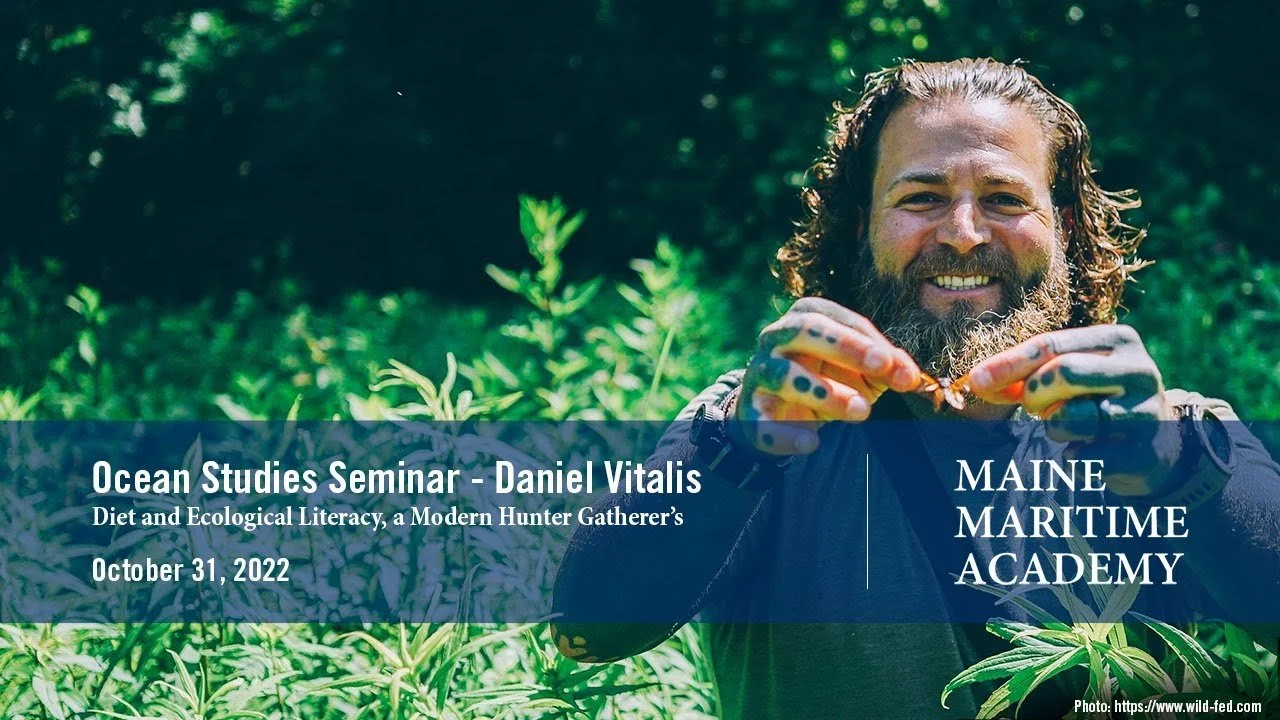
Watch Daniel’s presentation at Maine Maritime academy
in the field
In The Field is a blog featuring stories, recipes, tips and techniques from our hunting and gathering adventures.
Processing acorns into food is one of the most useful “survival skills” you could ever learn!
This is our homemade acorn flour — we make ours from red oak (Quercus rubra) because that’s our most abundant and easy-to-access species.
I believe that everyone in the oak-rich temperate regions of the world would be well served to learn how to process acorns into food. I’m not suggesting that people need to eat them often, rather, that they simply learn the skill. Since most of us live in a place where acorns can be foraged, we have the ability, in a pinch to make our own food security. Not that we’ll ever need it, but if we did, it’s nice to know where to turn.
For me, being WildFed — hunting, fishing, and foraging — is about a lot more than just getting my groceries. It’s an antidote to the Metaverse. These endeavors megadose you with reality. They’re real, actual experiences that nourish your senses with the authentic. Tangible, undeniable encounters in un-curated spaces and with the other-than-human beings with whom we share the biological world.
Our family headed out this year to "forage" our tree in the Arapaho-Roosevelt National Forest near our home in Colorado. Due to a recent wildfire that impacted the traditional cutting zone, our forest service opened up Christmas tree cutting to a much larger area, making it so we didn't have to travel very far from home to access. We went on the first weekend day available for our zone, and much like opening day of your favorite hunt, there were many people out to harvest their own wild conifer!
I made a lot of mistakes harvesting this doe. All that was required was a bit more presence.
It’s something we don’t talk about much, so I’ll broach the subject here. But first a story.
I set out quickly for my tree stand — doe tag in hand — after an intense conversation with a friend. I was there to support him but am also emotionally invested in the situation. I tried to walk quietly, to stay alert, since I could feel my distraction. Climbing up, I failed to check my surroundings. As I reached the top I saw two does bounding off, spooked by me, just 25 yards away. If I’d paused and looked around I could have had a clean shot on an animal unaware of my presence.
If you’re looking for an inroad to hunting, you’d be hard-pressed to find a better mentor than the squirrel.
While the above image is of a gray squirrel, it’s true of other members of the family Sciuridae too. Tree squirrels and ground squirrels. In Maine, I hunt gray squirrels, red squirrels, and groundhogs. Maybe where you live that would include fox squirrels, prairie dogs, or even arctic ground squirrels. Whatever the species, their anatomy is similar and so are breakdown and cooking methods.
Travis ‘Good Bull Man’ Condon and I harvested this bull along the Grand River, on Ron Brownotter’s ranch, the country’s largest native-owned bison operation. What I’d thought would be a simple, fenced, farm-style harvest quickly became a half-day search for a herd of several hundred animals freely roaming the 31 square miles of his rolling-hill prairie ranch land. It felt like we’d gone 500 years back in time.
Stream WildFed Seasons 1-5 on MOTV
It's the final episode of The WildFed Podcast, and Daniel and our show producer Grant Guiliano get together to reflect on the last few years of podcasting together, tie a bow on some of the recurring themes we've discussed on the show, as well as look to the future of WildFed.
They chat about the value in reconnecting with the species in your landscape, their thoughts on the future regulations of hunting and foraging, imposter syndrome, plans for a future podcast + a few teasers for Season 4 of the WildFed TV show, and more.
We're so incredibly grateful for your listenership and support over the years! Stay tuned for what's to come...